FBS Prints Team
Printing, Signage & Growth Specialists
ADA-compliant signage is an important accessibility requirement for covered commercial facilities. However, ADA requirements apply to specific types of signs rather than every sign in a building. Interior signage that identifies permanent rooms and spaces must meet specific technical standards, not just look professional.
In short: ADA-compliant interior signage for permanent room and space identification generally includes raised tactile characters and Grade 2 Braille, along with requirements for character size, contrast, finish, and mounting location.
What ADA Signage Actually Requires
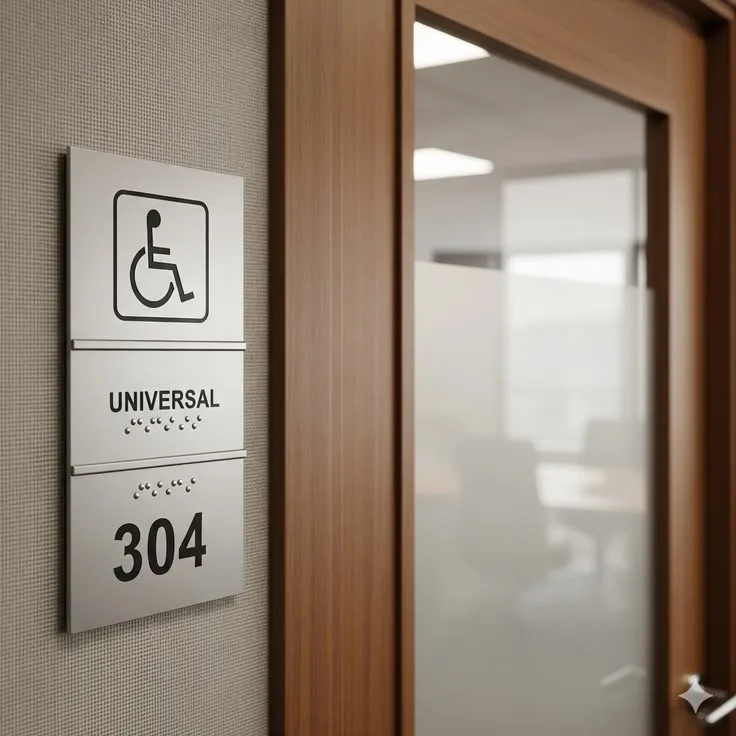
The 2010 ADA Standards for Accessible Design, enforced by the U.S. Department of Justice, set specific technical requirements for signs identifying permanent rooms and spaces, including restrooms, room numbers, and similar fixed locations. These signs generally need:
Raised (tactile) characters — uppercase, sans-serif characters that meet ADA requirements for height, spacing, stroke thickness, and raised elevation
Grade 2 Braille — positioned below the corresponding tactile characters and meeting the required dot specifications
High contrast — characters and backgrounds must provide sufficient contrast, with a non-glare finish to improve readability
Correct mounting height — tactile characters must be located within the ADA's specified mounting-height range, measured from the finished floor according to the applicable character-baseline requirements
Correct placement — signs identifying permanent rooms and spaces are generally positioned at the latch side of the door, with clear floor space allowing someone to approach and read the sign
Not every interior sign needs all of these features. Directional and informational signs, such as signs pointing toward a department or exit, may follow different ADA requirements than permanent room-identification signs.
Where ADA Signage Applies
For Belvidere businesses, ADA signage requirements can apply to covered commercial facilities open to the public, including offices, retail spaces, medical buildings, and multi-tenant properties. Common applications include:
- Restroom identification signs
- Room and suite numbers
- Permanent room identification signs
- Stairway and exit identification
- Directional and wayfinding signs, where applicable
What Goes Into Getting It Right
Several details need to be considered when producing ADA-compliant signage. Font selection is important because tactile characters must meet specific requirements for character style, proportions, spacing, and readability. Mounting height also needs to be measured precisely according to the applicable ADA standards.
Braille translation and placement require careful attention as well. Errors may not be obvious to someone who does not read Braille, which makes accurate production and quality control especially important.
A design proof before production can help catch spacing, contrast, and layout issues. However, technical specifications such as character dimensions, Braille requirements, and mounting locations must follow the applicable accessibility standards rather than being adjusted simply for design preference.
Frequently Asked Questions
Does every interior sign need to be ADA compliant?
No. ADA requirements generally apply to specific types of signs, including signs identifying permanent rooms and spaces. Directories, temporary notices, and certain informational signs may have different requirements.
What height should ADA signs be mounted at?
Tactile characters on ADA signs must meet the ADA's specified mounting-height requirements, which are measured from the finished floor according to the applicable character-baseline requirements.
Do ADA signs need Braille?
Permanent room and space identification signs generally require Grade 2 Braille along with raised tactile characters. Specific requirements should be reviewed against the current ADA Standards for the project.
Who is responsible for ADA sign compliance?
Responsibility for ADA compliance can depend on the property, project, and parties involved. Building owners, businesses, designers, architects, and sign professionals may each have responsibilities, so requirements should be reviewed for the specific project.
Can existing signage be retrofitted instead of fully replaced?
Often, yes — non-compliant signs can sometimes be replaced individually rather than requiring a full building-wide overhaul, depending on the scope of the issue.
Getting It Right the First Time
Because ADA standards establish specific accessibility requirements, non-compliant signage can create accessibility concerns and may require costly corrections. Working with a sign fabricator familiar with ADA specifications can help ensure the signs are designed and produced according to the applicable requirements.
For the most current and authoritative information, businesses should review the U.S. Department of Justice's 2010 ADA Standards for Accessible Design.
Author Biography
FBS Prints Team
FBS Prints helps businesses grow with practical signage, printing, direct mail, web design, and SEO guidance built around real-world execution.
Next Step
Need help applying this to your business?
Explore the related service page for a deeper breakdown, then contact our team for a quote or project guidance.